Leeds is a large and diverse city, home to communities of people from different backgrounds, with different characteristics and interests.
We put communities at the centre of our approach to public health in Leeds. This means working with and for communities, rather than doing something to communities. This helps us improve health, keep people safe, and make sure everyone can access health and wider services. Leeds has been working this way for many years. Over recent decades, research has consistently shown that building strong, connected communities is a sustainable and effective way to improve health outcomes.
This report celebrates our work with communities and how it improves health and wellbeing and helps reduce inequalities in Leeds, including:
- why we work in this way, including an explanation and summary of national and international evidence
- examples of brilliant work with communities that has made a difference
- recommendations to further improve this way of working in Leeds
What is a community?
Communities share something in common. They give us a feeling of belonging and connection to others.
Community has been described as “the relationships, bonds, identities and interests that join people together or give them a shared stake in a place, service, culture or activity” (1).
What are the different types of community?
- Communities of people who face high levels of disadvantage, such as the Gypsy and Traveller community or asylum seekers and refugees.
- Communities with shared characteristics and identity, such as faith communities, older people, people who are Lesbian, Gay, Bisexual or Trans (LGBT+).
- Communities with shared interests, hobbies or backgrounds, such as sports groups.
- Communities who live close to each other in the same neighbourhood or local area.
As this shows, communities are complex. Most of us are part of several communities, and these change over time. As we get older and our lives change, we might move house, develop new identities or take up new interests. It is important not to place people into "boxes" or talk about communities in isolation. People’s experiences and identities are shaped by many aspects of their lives.
What are health inequalities?
Health inequalities are avoidable, unfair and systematic differences in health outcomes, access to health care and opportunities for healthy living between different groups of people. These differences are not random. They are driven by inequalities in society, including income, education, discrimination and where people live.
Life in Leeds: Communities and assets in the city*
- 845,200 people live in Leeds
- Around a quarter of people are from ethnically diverse communities
- Around 1 in 10 people live in the least deprived 10% of areas nationally
- 30 VCS Community Anchors
- 222 primary schools
- 40 secondary schools (and 4 through schools)
- 5 further education colleges
- 5 universities
- Around 1 in 5 people (1 in 4 children, 1 in 10 older adults) live in the most deprived 10% of neighbourhoods nationally
- Over 70,000 people in Leeds have a main language that is not English. For example, 4,697 speak Romanian, and 2,898 speak Kurdish
- 31,500 volunteers, and 6,465 employees working in 3,375 VCFS organisations
- 34 Neighbourhood Networks supporting older people
- 87 GP practices
- 99 councillors
- 250+ sporting groups
- 150+ established places of worship
(Sources: ONS 2021, 2024; IMD 2025; LCC and partners data).
*All communities in Leeds have strengths and resources, often described as "assets", that can support health and wellbeing. These include parks and green spaces, local services such as schools, and the knowledge and relationships held by VCFS organisations. Community-centred approaches recognise, build on and strengthen these assets, especially where barriers exist.
Communities create good health and wellbeing

(BARCA Better Together gardening group; picture courtesy of BARCA Leeds).
Health and wellbeing is shaped by the conditions people experience throughout their lives, including their homes, their work and their communities. People’s health improves when they feel connected, included and able to take part in decisions that affect their lives.
Communities can create a sense of belonging, build relationships and be a source of joy. This was clear during the COVID-19 pandemic, when neighbours supported each other by offering friendship, sharing food and providing practical help. Across the city, many people volunteer in their neighbourhoods, and communities are already taking action to improve health and wellbeing.
However, not all communities have the same access to these benefits. Some people experience discrimination, exclusion or a lack of power and control, which can limit opportunities to build connections and protect health. This is why trusted community organisations that work closely with communities play such an important role in improving health and reducing inequalities. Later in this report, we share examples of how organisations like these make a difference to health and wellbeing.
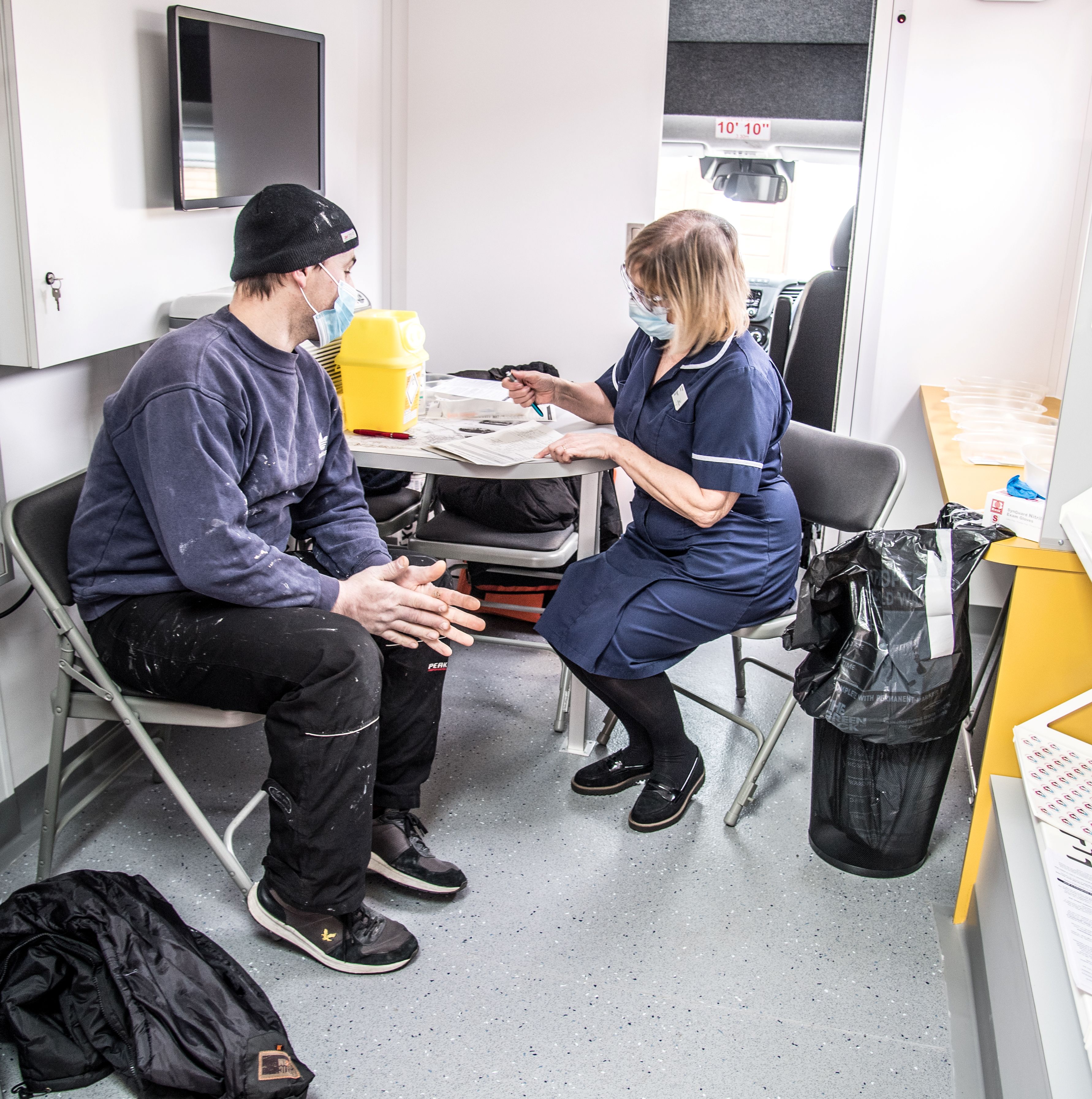
(Improving Access - COVID vaccination outreach on the NHS mobile clinic; picture courtesy of Leeds CCG).
How people in Leeds feel about their communities
The Community Life Survey tells us how people feel about their communities and their role within them. In Leeds:
- 22% feel they can influence decisions in their local area
- 73% are satisfied with their local area as a place to live
- 54% have volunteered in the last 12 months
- 34% believe many people in their neighbourhood can be trusted
- 6% often or always feel lonely
- 78% agree that their local area is a place where people from different backgrounds get on well together
People in Leeds are more likely to be satisfied with their local area and feel that people can be trusted than some other large cities.
(Source: Community Life Survey 2024/25).
What do we mean by "community-centred" approaches?
We work with and for communities to make the greatest difference to health and wellbeing and reduce inequalities in Leeds. This is not just about being physically present in communities – it is about involving people in a meaningful way, and ensuring different groups are included. It recognises that people are experts in their own lives and best placed to define the solutions they need. This is particularly important for groups facing the greatest disadvantage and extreme health inequalities. Public health teams, local government, the NHS, VCFS organisations and other partners all have an important role to play as part of this.
Community-centred approaches are practical, evidence-based approaches that:
- use non-clinical, community-level approaches
- shape the building blocks of health
- increase people’s control over their health and lives
- actively involve community members throughout the process
- improve connection and networks
- remove obstacles to involvement, for example, transport
Communities know what they need and have the wisdoms and solutions to achieve change.
Case Study: Leeds Community Anchor Network – connecting community organisations working to ensure the communities of Leeds thrive
The Leeds Community Anchor Network (LCAN) is a city-wide network of 30 trusted VCFS organisations. The network formed in 2022 to build on the connections and partnerships made during the COVID-19 pandemic. LCAN brings together organisations whose purpose is to ensure the communities of Leeds thrive, working in collaboration rather than competition. This includes:
- Delivering the Neighbourhood Matching Programme, which provides funding to projects chosen by local volunteers in return for their time volunteering. This programme shifts power to communities to set their own local priorities. In total, 46 volunteer-led projects have been funded through the time of 676 volunteers, raising £58,100. Projects have included residents spending time litter picking to fund new bins in Holbeck and volunteers growing and cooking vegetables in Seacroft.
- Co-ordinating the Welcome Spaces Network of local trusted organisations providing community spaces where people can gather for free in a warm, safe place and enjoy a hot drink and some company. Some provide activities and sessions, such as cooking. In winter 2024-25, 30 LCAN members co-ordinated a network of over 200 Welcome Spaces in the city, with 65,653 visits from residents (4).
Community is important. It is not about what is happening but the people forming connection with one another.
Communities at the centre of local and national strategy
Ensuring communities are involved and empowered, particularly those facing disadvantage, is central to strategies and approaches in Leeds.
In 2025, the Leeds Ambitions were launched by Leeds City Council and partners in the city, setting out 4 overarching ambitions for Leeds to be a healthy, growing, thriving and resilient city. Community-centred approaches will help deliver these ambitions. Key local strategies and programmes of work that support this include:
- The Joint Health and Wellbeing Strategy (2023–30).
- Our Leeds commitment to being a Marmot City.
- Community power in the city, expanding on work to shift power to people and enabling communities to thrive.
- The Third Sector Strategy (2023-2028) to ensure the VCFS is diverse, resilient and better able to continue supporting our communities.
- The Leeds Volunteering Strategy (2023) celebrating and supporting volunteering.
In addition, new national directions provide opportunities for community-centred approaches and will have a significant impact on Leeds:
- In 2025, the new 10 year Health Plan for England was published, setting out a new approach to delivering Neighbourhood Health.
- The national Pride in Place approach, enabling residents, businesses, and community groups to deliver real improvements that matter to local people, will include 4 neighbourhoods in Leeds (Middleton Park Avenue, Farnley East, Seacroft, Armley and New Wortley).
Neighbourhood Health in Leeds
Neighbourhood Health is a partnership approach to delivering co-ordinated, accessible and preventive health and care services in a local community. Leeds is a national pilot site for Neighbourhood Health (National Neighbourhood Health Implementation Programme) in Chapeltown, Beeston, Middleton and Hunslet, Cross Gates and Seacroft. Learning from this will help develop Neighbourhood Health approaches across the city.


