Table of contents
Transparency report Core Report
1. A1 What we are responsible for maintaining
2. A2 Road conditions in Leeds
3. A3. What we are doing about potholes and other road defects
4. A4 What we spend to maintain the highway network and where the funding is coming from
5. A5. Our maintenance plans for this year
Transparency report – Technical Annex
6. B1 Highways maintenance funding and spending figures
7. B2 Highway Maintenance Activity (Surface Treatments and Repairs)
8. B3 Pothole repairs
9. B4 Maintenance of highway structures
10. B5 Asset Management
11. B6 Maintaining footways and cycleways
12. B7 Drainage
13. B8 Skills and training
14. B9 Adapting roads to withstand climate pressures
15. B10 Innovation
16. B11 Working with utility companies to reduce disruption to road users
17. B12 Managing highways maintenance contracts effectively
Transparency report Core report
How we maintain local roads, pavements, and the wider highway network in Leeds City Council.
A1 What we are responsible for maintaining
Through the delivery of the highway maintenance service Leeds City Council recognises the importance of the associated highway infrastructure assets and how an effectively maintained and managed network both contributes to the local economy and supports the Council in achieving its corporate priorities. The Council understand that effective Asset Management is a platform to deliver clarity around standards and levels of service, and to make best use of available resources.
The highway network in Leeds is both large and complex and for this reason we are required to undertake a significant variety of tasks which often require specialist knowledge to ensure we maintain our assets to the best possible standard with the resources available.
These assets include:
- Carriageways – total length 2982km
- Footways – total length 5663km
- Structures inc. Bridges – total number 1005
- Street lighting assets – total number 112,830 inc. illuminated traffic signs and bollards
- Drainage Assets – total number 151,328 gullies, and 42.6km linear drainage
- Traffic Signals – total number 739
- Flood Prevention Assets - total number 497
It should be noted that whilst the above list represents many of our CORE assets, we are also responsible for the maintenance of many others including vehicle restraint systems, pedestrian guardrail amongst others.
Key Challenges include:
- rising costs, including materials, labour, energy and delivery
- limited funding relative to the size, age and condition of the asset portfolio
- delays in the delivery of high-speed communications infrastructure by third-party telecommunications providers
- prolonged and recurring extreme weather events causing increased asset failures and deterioration
- limited contractor market, resource availability, key competencies, innovation and value for money
- obsolescence of legacy equipment and difficulties sourcing replacement items
- increase in misinformation through Social Media platforms
- increasing Stakeholder expectations and
- potential changing Political climate
A2 Road conditions in Leeds
A2.1 A roads
| Year | Percentage of road in red category | Percentage of road in amber category | Percentage of road in green category |
|---|---|---|---|
| 2023 | 3% | 11% | 86% |
| 2024 | 2% | 19% | 79% |
| 2025 | 4% | 21% | 75% |
A2.2 B and C roads
| Year | Percentage of road in red category | Percentage of road in amber category | Percentage of road in green category |
|---|---|---|---|
| 2023 | 2% | 12% | 86% |
| 2024 | 2% | 17% | 81% |
| 2025 | 2% | 19% | 79% |
A2.3 U roads
| Year | Percentage of road in red category |
|---|---|
| 2023 | 20% |
| 2024 | 20% |
| 2025 | 24% |
Councils use road condition surveys to assess the state of their roads. The results are grouped into three categories:
- green – the road is in good condition and no further investigation or treatment is required
- amber – the road may need maintenance soon
- red – the road is in poor condition and should be considered for maintenance
The published official statistics for road condition include more detail about the methodology, timing and coverage of this data.
A2.4 Additional information on carriageway condition
We undertake Surface Condition Assessment for the National Network of Roads (SCANNER) laser-based surveys of our principal, distributer and some unclassified roads every 2 years (50% each year). For the remainder of the unclassified network, we undertake condition assessments (AEI Leeds variation). Leeds is maintaining a declining network with figures for the A roads around 2-4% for the last 5 years. B & C roads around 2% with the unclassified network showing the greatest fluctuations in figures.
From 2026/27 we are also using a new methodology of road condition assessments based on the BSI PAS 2161 standard. This new standard will categorise roads into five categories instead of three to help government gain a more detailed understanding of road condition in England.
The transition to PAS 2161 will see greater use of Artificial Intelligence to monitor the condition of the network more frequently and also introduce a greater level of consistency when determining priorities and how best to allocate the available resource.
A3 What we are doing about potholes and other road defects
A3.1 What is a pothole
There is no specifically adopted definition of a pothole, but the European Research Association definition is generally accepted:
‘a local deterioration of the pavement surface in which the material breaks down in a relatively short time and is lost causing a steep depression’
All highway defects are subject to a risk-based categorisation depending on their size and location in the highway. The Highway Infrastructure Asset Management Plan sets out the proposed repair periods, with Category 1 defects due for repair before the end of the next working day following identification. Category 2 repairs within 7 days, and Category 3 repairs withing 28 days. Some Category 2 and 3 reports may be reassessed and their repair delayed, for example where a planned maintenance scheme is proposed.
A3.2 What we are doing to tackle potholes
The issue of Potholes on UK roads is often raised as a top concern for many. Unfortunately, despite our best-efforts new potholes can quickly form, increase in size, and can often be found in clusters occurring in a similar time frame. The increase in recent years appears to have been reflected across the country where the effects of the second wettest year in 2023 since records began in 1836, have resulted in a similar issue.
In 2025/26 20,938 carriageway potholes were repaired. With a busy urban network most repairs are temporary to ensure compliance with the repair timescales. The repair teams use hot laid material to increase the effectiveness and longevity of the repair.
Highway assets are maintained using asset management principals. Significant Leeds Capital funding supplements the available national funding, to ensure a mix of preventative and structural repair treatments, to maintain the asset in the best possible condition. In the 2026/27 programme of works 56% by length are structural works and 44% preventative treatments.
To tackle the pothole problem two separate, Leeds funded initiatives have been established. A £1M pothole patching programme, uses innovative and traditional repair techniques to permanently patch those streets with a recent history of temporary pothole repairs. This raises the carriageway condition to an acceptable standard, suitable for future preventative treatments. An extraordinary £1M fund has been established to trial a programme of dispersed permanent pothole repairs. This agile team utilises the Pothole Pro machine and dedicated mobile traffic management to target high profile routes and those requiring additional traffic management.
These programmes are being evaluated to find the most effective way of increasing the proportion of first-time permanent patch repairs, tackling the repairs on traffic sensitive locations and avoidance of repeat repair visits.
A3.3 How members of public can report potholes and other highway defects
The public can report potholes and other highway defects through multiple channels. Emergency defects that pose an immediate risk to people or property should be reported via the council's highways emergency telephone service on 0113 222 4407.
Non-urgent defects can be reported by the public online through the Customer Access Transactional Services (CATS) platform. CATS incorporates GIS mapping to accurately locate defects, records details electronically, and automatically assesses severity to prioritise reports for inspection and repair in accordance with council service standards.
Reports can be submitted at: https://www.leeds.gov.uk/parking-roads-and-travel/report-an-issue-with-a-road-or-pavement.
A3.4 What happens after a pothole is reported
Information about the defect from the customer services system is assessed (usually a desk-top exercise) by a technician to determine the correct risk-based categorisation, depending on their size and location in the highway, and to plan the repair.
Works requiring traffic management are planned separately but all other repairs are passed to dedicated response teams. These teams are made up of 2 operatives operating from a single vehicle with a hot box to store the asphalt repair material at the required temperature and can repair between 20 and 25 locations each day.
A4 What we spend to maintain the highway network and where the funding is coming from
A4.1 Spending on highways maintenance
|
Annual spend of which is spent on: |
2024-25 |
2025-26 |
2026-27 (projected) |
|---|---|---|---|
|
Carriageways |
£24,099,497 |
£22,093,338 |
£24,817,416 |
|
Footways |
£4,634,519 |
£4,248,719 |
£4,772,580 |
|
Structures (for example bridges or tunnels) |
£8,455,367 |
£10,403,118 |
£12,196,200 |
|
Drainage |
£397,381 |
£681,681 |
£527,470 |
|
Street lighting (excludes PFI costs) and Traffic Signals |
£4,930,624 |
£3,182,188 |
£1,995,100
|
|
Other assets |
£2,162,775 |
£1,982,735 |
£2,227,204 |
|
Total spend on highways maintenance |
£44,680,163 |
£42,591,779 |
£46,535,970 |
A4.2 Where our funding for highways maintenance comes from
| Funding sources for highways maintenance | 2024-25 | 2025-26 | 2026-27 (projected) |
|---|---|---|---|
| Funding received through the Department for Transport / UK Government |
£24,263,763 |
£20,294,429 |
£15,322,539 |
| Additional highways maintenance funding provided by the Council or third parties |
£20,416,400 |
£22,297,350 |
£31,213,431 |
| Total | £44,680,163 | £42,591,779 | £46,535,970 |
A5 Our maintenance plans for this year
A5.1 Our plans for highways maintenance for 2026-27
The objective of a good asset management strategy is to determine the proportion of structural and preventative maintenance work that should be carried out for each hierarchy of road and footway.
Leeds has developed a whole life highway asset maintenance model which ensures a balance between structural and preventative maintenance treatments by considering the current condition and rate of deterioration for each street.
Current levels of funding allow approximately 100-200 structural maintenance schemes and 200-300 preventative maintenance schemes each year.
In 2026/27, we are aiming to undertake the following:
- apply Preventative Road surface treatments (Surface Dressing, Micro Asphalt) to 78.1km of our network
- undertake planned Structural maintenance to 62.3km of our road network
- undertake planned maintenance to 43.9km of our pavements
- undertake a road patching programme covering a total of 47,740m²
A5.2 Full list of planned carriageway and footway works
Due to the size of the programme of planned works, it is considered impractical to insert the full lists here, however an Interactive Map showing details of our Annual works programme can be found using this link:
Alternatively, the link below will take you to a copy of our approved report and a list of roads that are to be attended to in 2026/27, along with our provisional forward programme to 2030/31 can be found at Appendix B:
https://democracy.leeds.gov.uk/ieDecisionDetails.aspx?ID=58680
Likewise, details of our structures programme can be be found using the link below and then Appendix C:
https://democracy.leeds.gov.uk/ieDecisionDetails.aspx?ID=58700
A5.3 How decisions are made on our maintenance plans
The formalised prioritisation criteria ensure that available funding is matched to sites that have the greatest need or the greatest benefit in a consistent, fair and cost-effective manner city wide.
Schemes not added to the Annual Works Programme remain on the Forward Works Plan. If subsequent inspections of these streets reveal additional defects, they may be re-rated and their priority changed accordingly.
Annual Works Programme Flowchart
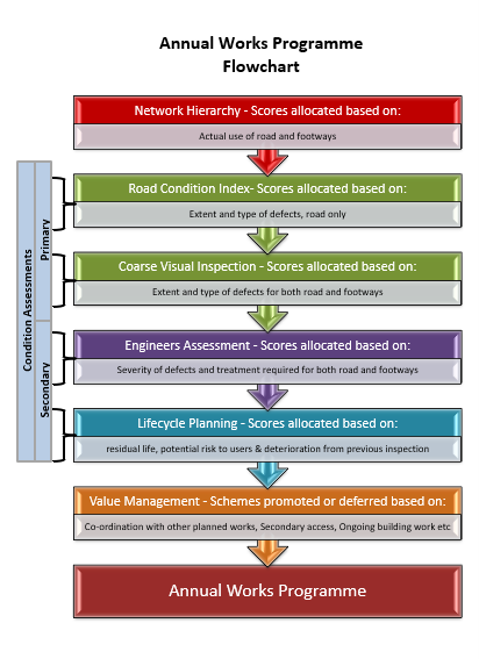
Network Hierarchy
Scores allocated based on: Actual Use of road and footway.
Condition Assessments - Primary
Road Condition Index
Scores allocated based on: Extent and type of defects for both road and footways
Coarse Visual Inspection
Scores allocated based on: Extent and type of defects for both road and footways
Condition Assessments - Secondary
Engineers Assessment
Scores allocated based on: Severity of defects and treatment required for both road and footways
Lifecycle Planning
Scores allocated based on: Residual life, potential risk to users and deterioration from previous inspection
Value Management
Scheme promoted or deferred based on: Co-ordination with other planned works, Secondary access, Ongoing building work etc.
Annual Works Programme
Transparency report Technical Annex
B1 Highways maintenance funding and spending figures
B1.1 Capital funding allocation sources
| Financial year | 2024-25 | 2025-26 | 2026-27 (projected) |
|---|---|---|---|
| Highways maintenance capital funding allocated through DfT | £22,808,963 | £15,642,833 | £10,432,633 |
| Other DfT capital funding utilised by local authority for highways maintenance | £1,454,800 | £4,651,596 | £4,889,906 |
| Other Government capital funding allocated by local authority to Highways Maintenance | £0 | £0 | £0 |
| Other capital funding allocated to highways maintenance | £13,762,918 | £15,245,852 | £25,193,431 |
| Total Capital funding allocated to highways maintenance | £38,026,681 | £35,540,281 | £40,515,970 |
B1.1.2 Additional information on funding figures
In addition to the 5-year CRSTS allocation, we also receive pothole or Local Highways Maintenance Fund (LHMF) Top Up funding. Available capital funding is also allocated directly from the councils budget setting process and this has been at a largely consistent value of £13m per year. In general, the CRSTS funding is used to undertake works on the Principal, Distributor and UnClassified elements of the network and the Leeds Capital funding is used to fund the Local RoadS (LRS) Programme. Increasingly, the aim is to carry out more preventative works to ensure more of the network is retained in a good condition whilst seeking to address those elements that are life expired.
B1.2 Spending
B1.2.1 Total spending
| Please confirm that you understand the answers provided in this section (B1.2.1) relate to your compliance under the 2026-27 local highways maintenance incentive funding requirements, as set out to your authority via letter to your chief executive in April and as published online. | Yes |
| Financial year |
2024-25 |
2025-26 |
2026-27 (projected) |
|---|---|---|---|
| Total highways maintenance capital spend |
£38,026,681 |
£35,540,281 |
£40,515,970 |
|
Total highways maintenance revenue spend |
£6,653,482 |
£7,051,498 |
£6,020,000 |
| Total spend |
£44,680,163 |
£42,591,779 |
£46,535,970 |
B1.2.2 Additional information on total spending figures
In addition to the routine capital and revenue allocation, a key expectation of our stakeholders is to tackle the problem of potholes. With this in mind two separate, Leeds funded initiatives have been established. A £1M pothole patching programme, aimed at techniques designed to permanently patch repair those streets with a history of temporary pothole repairs. Along with an extraordinary £1M fund has been established to trial a programme of dispersed permanent pothole repairs. In is recognised that the adverse effect of wetter, longer winters will only increase the pressure on the service, and it is essential that we have a robust and timely approach to dealing with potholes.
B1.2.3 Spending on carriageways by type of spend in financial year 2025-26 and 2026-27 (projected)
| Carriageway spend related maintenance type |
Capital 2025-26 |
Revenue 2025-26 | Capital 2026-27 (projected) | Revenue 2026-27 (projected) |
|---|---|---|---|---|
| Planned maintenance | ||||
| Preventative carriageway maintenance |
£3,627,000 |
£1,153,019 |
£3,698,670 |
£1,000,000 |
| Structural carriageway maintenance |
£14,699,070 |
£1,571,470 |
£18,444,480
|
£1,500,000 |
| Planned carriageway repair / patching programmes |
£1,661,097 |
£0 |
£1,180,000 |
£0 |
| Reactive maintenance |
|
|
|
|
| Reactive carriageway repairs / patching (temporary repairs) |
£0 |
£922,415 |
£0 |
£800,000 |
| Reactive carriageway repairs / patching (permanent repairs) |
£ 945,580 |
£1,032,797 |
£2,180,000 |
£850,000 |
| Reactive carriageway repairs / patching (total) |
£ 945,580 |
£1,955,212 |
£ 2,180,000 |
£1,650,000 |
|
Other carriageway‑related spend |
£ 1,407,153 |
£1,305,192 |
£1,257,050 |
£907,000 |
| Total |
£22,339,900 |
£5,984,892 |
£26,760,200 |
£ 5,057,000 |
B1.2.4 Additional information on spending on carriageways by type of spend
The City Council recognise the absolute significance of the condition of our carriageway network and significant capital funding is allocated as part of annual capital review process
In addition to the above, and with reference to section B11, following recent DfT approval the authority Lane Rental scheme will Go Live from 05 October 2026. When implemented the scheme will require that 50% of surplus revenue will be ringfenced to highway maintenance. This table excludes costs related to traffic lights.
B2 Highway maintenance activity (surface treatments and repairs)
B2.1 Road resurfacing and surface treatments
| Financial year |
Road receiving preventative road surface treatments (length, km) |
Road receiving planned structural maintenance (length, km)
|
Area receiving planned repair / patching programmes | Area receiving reactive repair / patching (permanent methods) | Area receiving reactive repairs/ patching (temporary methods) |
|---|---|---|---|---|---|
| 2025-26 |
34.4km |
48.3km |
32922m2 |
n/a |
n/a |
| 2026-27 projected |
78.1km |
62.3km |
47740m2 |
n/a |
n/a |
B2.1.1 Additional information on surface treatments and repairs
| Does table B2.1 reflect all your carriageway-related road surface treatments & repair activities (for example, including pothole repairs? | Yes |
B2.1.2 Further information and context
| In addition to the above, and with reference to section B11, the authority Lane Rental scheme will Go Live from 05 October 2026. The scheme will require that 50% of surplus revenue to be ringfenced to highway maintenance. | Yes |
B3 Pothole repairs
B3.1 Pothole/Defect intervention criteria
| Pothole/Defect category name (as used by your authority) | Minimum investigatory or definitional threshold (e.g. depth, area, width – include units) | Additional risk or contextual factors considered (e.g. road hierarchy, traffic levels, location in carriageway) | Target response time – make safe | Target response time – permanent repair |
|---|---|---|---|---|
|
Pothole (Carriageway) |
Greater than 40mm |
Location in carriageway, depth, size, proximity to pedestrian crossing |
CAT1 Severity – End of next working day CAT2 – 7 Calendar Days CAT3 – 30 calendar days |
n/a |
|
Sunken Trench or abrupt level difference |
Greater than 40mm |
Location in carriageway, depth, size, proximity to pedestrian crossing |
CAT1 Severity – End of next working day CAT2 – 7 Calendar Days CAT3 – 30 calendar days |
n/a |
|
Iron work – Cover / Frame |
Missing |
Location in carriageway, depth, size, proximity to pedestrian crossing |
CAT1 Severity – End of next working day CAT2 – 7 Calendar Days CAT3 – 30 calendar days |
n/a |
|
Iron Work – Cover / Frame : Rocking or depressed |
Greater than 40mm |
Location in carriageway, depth, size, proximity to pedestrian crossing |
CAT1 Severity – End of next working day CAT2 – 7 Calendar Days CAT3 – 30 calendar days |
n/a |
B3.1.1 Further context
The work that we undertake in Leeds is intended to ensure that as far as reasonably practicable, a first-time fix is achieved i.e. at the time of the make safe and as such the need to return to undertake a permanent repair is avoided.
Increasingly we are seeing an increase in claims generated using Artificial Intelligence and photographs downloaded from the internet. It is therefore essential that we repair as many defects as possible in the first visit and also continue to work with our partners, including insurers to reduce the impact of fake claims.
B3.2 Number of potholes filled
| B3.2.1 - Number of potholes filled in 2025-26 | 20,938. |
B3.2.2 - Of these how many do you estimate were resolved using each of the following approaches:
| Planned repair / patching programmes | Planned structural maintenance programmes | Reactive repair using temporary repair methods | Reactive repair using permanent repair methods |
|---|---|---|---|
| 34.4km | 48.3km | 20,938 | n/a |
B3.2.3 Additional information on numbers of potholes resolved, by treatment type
A quantifiable record of the number of potholes repaired would only be captured during reactive repairs. Planned repairs, patching and structural maintenance would all be measured in kilometres of road repaired.
CAUTION FOR READERS – Authorities have different criteria for identifying potholes and different methodologies for counting how many they have filled or resolved. Summing the figures in the above table across authorities will therefore not provide a reliable estimate of the total number of potholes filled across England.
B3.3 Prices of pothole interventions
| Unit/average cost of a permanent pothole repair on your network (reactive) | £74.16 /m2 | Unit/average cost of a temporary pothole repair on your network (reactive) | £77.60 |
B3.3.1 Additional information on pothole
Permanent repair price is currently under review as part of an agile permanent repair trial.
B3.4 Defect repair quality
| ID | Question | Yes/no |
|---|---|---|
| 3.4.1 | Do you set requirements to those delivering repairs about the longevity of both a) planned repairs/patching and b) reactive repairs using permanent methods? | Yes |
| 3.4.2 | If yes, do you base your material and process specifications on these longevity requirements? | Yes |
| 3.4.3 | Do you regularly monitor the appropriateness of the carriageway interventions chosen by your workforce or contractor and the quality of work delivered? | Yes |
| 3.4.4 | If yes, do you systematically record information about expected and delivered longevity of repairs? | Yes |
B3.4.5 Evidence summary
The Council operates a ‘one service’ approach to highway maintenance. Most reactive repairs are carried out by the in-house contracting unit. Working in collaboration the temporary repair process was planned to ensure longer lasting repairs to avoid repeat visits.
Regular planning meeting are held between the Asset Management and Delivery teams. The appropriateness and quality of treatment at specific sites may be raised at this forum.
B3.4.6 Additional information
When procuring other contractors and/or products a separate agreement is made vis a vis expected lifespan and guarantee of the repairs.
As part of the innovation evaluation trials, a sample of works will be selected in the future to establish the ongoing performance of the repair.
B3.5 Public reporting system for defects and other issues
| ID | Question | Answer |
|---|---|---|
| 3.5.1 | Are defect reports from the public routinely used as an input into maintenance planning and inspection regimes? | Yes |
| 3.5.2 | Do you inform users about the outcomes from their feedback, including when no action is to be taken? | Yes |
B3.5.3 Evidence Summary
Public reports via the emergency telephone service and the Customer Access Transactional Services (CATS) platform are geolocated and assessed in line with our risk criteria to determine whether intervention is required.
Valid reports are used alongside routine highways inspections to generate reactive maintenance activities.
For relevant service areas, and where contact details have been submitted and consent given, customers will receive updates on the outcome of their enquiry, including when no further action is required or when the reported defect fails to meet the council’s intervention criteria.
B3.5.4 Tools used for reporting
The Council uses its Customer Access Transactional Services (CATS) platform to enable the public to report highway defects online. The system allows users to identify defect locations using GIS mapping, provide supporting information and photographs. The enquiry generated is triaged before being added to the Council delivery workflow.
B4 Maintenance of highway structures
B4.1 Highway Structures
| ID | Question | Answer |
|---|---|---|
| 4.1.1 | Number of highway structures on your highway network | 1005 |
| 4.1.2 | Number of highway structures with interim measures in accordance with CS470 applied? | 43 |
| 4.1.3 | Number of structures due a General Inspection in 2025-26 in accordance with CS450 | 815 |
| 4.1.4 | Number of General Inspections carried out in 2025-26 | 809 |
| 4.1.5 | Number of structures due a Principal Inspection in 2025-26 in accordance with CS450 | 50 |
| 4.1.6 | Number of Principal Inspections carried out in 2025-26 | 40 |
B5 Asset management
B5.1 Asset management strategy and policy
| 5.1.1 | Please confirm that you understand the answers provided in this section (B5.1) relate to your compliance under the 2026-27 local highways maintenance incentive funding requirements, as set out to your authority via letter to your chief executive in April and as published online. | Yes |
| 5.1.2 | The following link can be used to access a copy of our published highways asset management policy and strategy. |
| 5.1.3 | Please provide the date it was last reviewed or updated | Date 14 March 2022 |
| 5.1.4 | Please provide proof of the review or update. |
|
The original Policy & Strategy documents were due to expire at the end of 2021. In readiness for this we commissioned an independent review which began with a scoping stage review was started in August 2021 and included 4 stages:
Over the subsequent 6 months a new and updated policy and strategy document was developed, and this was approved for publication on 14 March 2022. |
|
| 5.1.5 | Our existing Policy & Strategy document is valid until March 2027. A review will begin on or around November 2026, with the intention of seeking formal approval and sign off of our 2027 – 2031 document by February 2027. It is anticipated that a key update will be required to reflect the forthcoming update of the Well-Managed Highways Infrastructure Code of Practice. |
B5.1.6 Further context
| Item 12.1.1 of our Strategy document states ‘This HIAM strategy will be reviewed formally after 5 years; in the intervening period there will be light touch reviews at years 1 and 3 and relevant details will be updated as and when appropriate’. Some minor amendments took place in March 2025 to align with an annual plan review. |
Key aspects of highways asset management approach.
B5.2 Asset
| Asset type | Asset inventory held? (None / partial / full) | Condition data held? (None / Partial / Full) |
|---|---|---|
| Carriageways | Full | Full |
| Footways and cycleways | Partial | Partial |
| Structures | Full | Full |
| Drainage assets | Partial | Partial |
| Street lighting | Full | Full |
| Traffic signals | Full | Full |
B5.2.1
Asset inventory is the foundation on which asset management processes are to be built. When inventory is combined with condition data, an overall view and consistent management approach can be achieved.
Asset data, both inventory and condition are required to enable the council to effectively monitor and report on the condition of the highway network at any stage throughout its life. Develop future levels of service along with their associated performance indicators. Identifying future investment strategies, modelling future maintenance options, and developing long term forward programmes and budget needs. Also to conduct valuation assessments for each of the various assets and for predicting their depreciation over time.
B5.3 Asset data integration and management
B5.3.1 Asset data integration
How is asset inventory and condition data for your key highway assets primarily managed
| Discrete spreadsheets or documents held by individual teams | |
| Multiple digital platforms with limited integration | |
| A single digital platform or a set of connected platforms used across the highways service | X |
| Other (please set out in further context) |
|
B5.3.2 Further context
The service recently completed the implementation of the AMX Solutions asset management platform. Included with this was the rationalisation of four previous applications and the integration of three databases that held asset data relating to the Highway Asset Management, Structures & Bridges, Flood Risk Management and Highway drainage disciplines.
B5.4 Lifecycle planning and investment decision making
| ID | Question | Yes / No |
|---|---|---|
| 5.4.1 | Do you use lifecycle plans for carriageways to support maintenance investment decisions? | Yes |
| 5.4.2 | Do you use lifecycle plans for footways to support maintenance investment decisions? | Yes |
| 5.4.3 | Do you use lifecycle plans for structures to support investment decisions? | Yes |
B5.4.4 Evidence Summary
In addition to including the facility to undertake Lifecycle Planning as part of the AMX Asset Management solution, in order to better inform any future City Region Sustainable Transport Settlements (CRSTS) and Transport for City Regions (TCR) spending allocation, the West Yorkshire Regional Highways Infrastructure Asset Management (HIAM) Board commissioned the development of a carriageway deterioration model. The data from this modelling is subsequently being used to develop the TCR requirements for this and other core assets.
B5.5 Performance monitoring and continuous improvement
| ID | Question | Answer |
|---|---|---|
| 5.5.1 | Do you have a defined set of key performance indicators (KPIs) to monitor the outcomes of your highways asset management approach? | Yes |
| 5.5.2 | Are these KPIs reviewed on a regular basis (at least annually)? | Yes |
| 5.5.3 | Are KPI trends used to inform maintenance planning, prioritisation or changes to forward programmes or investment decisions? | Yes |
| 5.5.4 | Have you conducted a value for money review or peer review of your service in the last 3 years | Yes |
B5.5.5 Evidence Summary
In addition to those performance indicators that we are required to report on relating to road condition and those set out in returns such as the Alarm Survey or NHT survey, the service also operates a series of internal KPIs which are reviewed with Senior Management on a monthly basis. These are influenced by the wider council plan 2026 - 2030 along with the likes of our Climate resilience strategy and Transport Strategy.
B6 Maintaining footways and cycleways
| ID | Question | Answer |
|---|---|---|
| 6.1.1 | Do you have a defined footway hierarchy (e.g. based on footway function and usage levels) that underpins a risk‑based approach to inspection frequencies and maintenance programmes? | Yes |
| 6.1.2 | For 2026-27, please provide the length of footways that you have earmarked for structural maintenance / reconstruction / renewal | 43.9 km |
| 6.1.3 | For 2026-27, please provide the length of footways that you have earmarked for preventative maintenance treatments | 0 km |
| 6.1.4 | Are priority footways and cycleways included in your winter service (e.g. gritting or snow clearance), and in a routine programme for keeping them clear of overgrown vegetation and debris (e.g. sweeping, cutting back)? | Yes |
| 6.1.5 | For 2026-27, are you planning to deliver structural or preventative maintenance to cycleways which is not yet covered as part of your carriageway maintenance programmes or footway maintenance programmes (e.g. segregated cycleways that are not shared with pedestrians or motorists). If yes, please set out the length of such cycleways that you have earmarked for: | No |
| a. Structural maintenance / reconstruction (in km) | In km | |
| b. Preventative maintenance treatments (in km) | In km |
Highway footway and cycleway assets are continually monitored for condition and maintenance needs. Prioritised planned maintenance programs are developed to maintain the assets in a safe and serviceable condition appropriate for their use together with a view to minimising whole life costs.
B6.1.7 Evidence Summary
Despite the extensive amount of footway reconstruction works that we undertake each year, we have in recent years reluctantly taken the decision to suspend a previous programme of slurry sealing footways. This is due to a combination of a disproportionate level of public dissatisfaction when set against the limited benefit and as such the available funding has been reallocated to other highway works.
B7 Drainage
| ID | Question | Answer |
|---|---|---|
| 7.1.1 |
Please provide an estimate of your drainage maintenance expenditure split (in percentages) between:
|
|
|
20% | |
|
80% | |
| 7.1.2 | Does your authority utilise a digital drainage management platform, covering asset inventory, inspection history, sensor data, and risk scoring? | Yes |
| 7.1.3 | Do you maintain a record of locations where drainage issues are known to cause or contribute to carriageway deterioration or surface water ponding? | Yes |
| 7.1.4 | Do you utilise smart sensors or other remote monitoring technologies to monitor performance of your drainage assets. If yes please provide some high level information in bullet points below | Yes |
B7.1.5 Evidence Summary
The figures stated in 7.1.1 are for Gully Cleansing. For the maintenance of Highways Surface Water drainage assets, it’s 100% reactive currently. 7.1.2 we utilise a digital drainage management platform, but we don’t currently record sensor data or score risks. 7.1.4 we don’t currently use remote monitoring technologies, but this is something that is under consideration.
B7.1.6 Further context on approach to drainage asset management
The drainage asset is a substantial asset group within the Leeds City highway network, comprising of a number of asset elements. Owing to the nature of the differing maintenance needs these are managed more effectively by splitting then into two main groups:
1. Highways Drainage - Highway gullies, Linear drainage systems
2. Other Drainage Features – Culverts, Debris screens, Catchpits, Pumping Stations, Petrol Oil Interceptors, watercourses, etc
The condition of the drainage asset is proven to have a direct influence on the deterioration of other highway assets, in particular the carriageway. Leeds City Council has adopted a maintenance programme that seeks to minimise deterioration of other highway assets.
B8 Skills and training
| ID | Question | Answer |
|---|---|---|
| 8.1.1 | Do you have an up-to-date training and development plan for those responsible for highways asset management in your authority? | Yes |
| 8.1.2 | Do you or your main highways contractors support professional development through a recognised professional training scheme (e.g. Institution of Civil Engineers (ICE) or Institution of Highway Engineers (IHE))? | Yes |
| 8.1.3 | Does your authority contribute towards the cost of professional membership or professional development required for relevant highways roles? | No |
| 8.1.4 | Do you employ a professionally qualified engineer (e.g. Chartered Engineer (CEng) or equivalent competence) with responsibility for the management of highway structures (either in house or through a contracted arrangement)? | Yes |
| 8.1.5 | Does your authority define competence requirements for key highways asset management roles and take steps to address any identified gaps (either directly or through contractual arrangements)? | Yes |
| 8.1.6 | Do you or your main contractors support early career development in your local area, for example through apprentice schemes, traineeships or pre-apprenticeship programmes, sponsored qualifications (e.g. HNC/HND, degree, MSc), graduate schemes etc | Yes |
B8.1.7 Evidence Summary
Due to the wide range of disciplines required within Highways and Transportation, we aim as far as reasonably practicable to develop a workforce through the collective use of annual appraisals, succession planning and the adoption of best practice. All job descriptions set out essential and desirable skills and a minimum level of qualifications. Any requirements to refresh and/ or enhance knowledge and qualifications is discussed annually and progressed whenever deemed appropriate.
In addition to having an apprenticeship scheme, staff at all levels are also encouraged to develop through obtaining formal qualification’s from BTech, through to Degree level. We are also active and encourage attendance and engagement with technical bodies and the likes of LCRIG, ADEPT and APSE. As part of our partnership arrangement staff can also attend lunch & learn sessions including the WSP Local Government Skills Academy. Career development is actively encouraged.
B8.1.8 Further context on skills/training
The five West Yorkshire constituent authorities collaborate through the West Yorkshire Highway Infrastructure Asset Management (HIAM) Board to continuously improve regional highway asset management. By sharing data, knowledge, experience and best practice, they promote consistent, evidence-based and risk-based approaches that respect local priorities, governance arrangements and statutory responsibilities.
B9 Adapting roads to withstand climate pressures
Climate and environmental factors, such as heavy rainfall, prolonged heat, and freeze-thaw cycles, are integral to effective highways asset management, as they influence asset performance, deterioration rates and long-term resilience. Understanding both the impacts of a changing climate and the carbon implications of maintenance activities supports better decision-making, helping authorities to optimise durability, manage risk and deliver best whole life value from their assets.
| ID | Question | Yes/no |
|---|---|---|
| 9.1.1 | Have you updated your asset management policy and strategy to reflect the increased probability of extreme-weather and/or geohazards now and in the future? | Yes |
| 9.1.2 | Have you identified your resilient network and agree this with senior decision-makers | Yes |
| 9.1.3 | If yes when did you last update this. | March 2022 |
| 9.1.4 | Have you identified locations that are repeatedly affected by extreme weather (e.g. flooding, heat damage, storms)? |
Yes – known informally
|
| 9.1.5 | Which climate‑adaptation measures are currently implemented on your network? | |
|
Yes | |
|
Yes | |
|
Yes | |
|
No | |
|
Yes | |
|
Yes | |
|
No | |
| 9.1.6 | Have you measured and benchmarked the greenhouse gas emissions from your highways maintenance service using a recognised industry standard? Or do you have arrangements in place to do this, such as by signing up to the DfT funded ADEPT Carbon Leadership Programme. | Yes |
| 9.1.7 | Have you formally engaged with the DfT funded ADEPT live labs 2 Programme, to understand what lessons your authority can utilise to increase the efficiency of your operations and support decarbonisation efforts? | Yes |
B9.1.8 Evidence summary
Our Highways Resilient Network has traditionally been identified in collaboration with regional partners and was last updated in September 2021 as part of preparation for the West Yorkshire Combined Authority City Region Sustainable Transport Settlement bid. The map shown here indicates the extent of the Resilient Network across Leeds and the wider West Yorkshire region, supporting regional resilience of key highway links.
B9.1.9 Further context on our adaptation/resilience activities
The Resilient Network is used to help understand the highway links that are most important for maintaining movement during disruption, including severe weather events. It supports coordination with the West Yorkshire regional network and helps inform prioritisation, emergency planning, winter service considerations and investment decisions where network resilience is a key factor. Review of this and other network hierarchies is an ongoing process due to the nature of development and change within the city along with the increasing frequency and severity of natural events.
B10 Innovation
| ID | Question | Yes / No |
|---|---|---|
| 10.1.1 | Do your procurement and contracting approaches encourage and reward innovative practice? | Yes |
| 10.1.2 | Can you demonstrate that innovative materials and practices are regularly reviewed and, where appropriate, integrated into business as usual operations? | Yes |
| 10.1.3 | If you have conducted innovation trials, have you shared the findings of these publicly or with professional networks? | Yes |
10.1.4 Evidence summary
A Highways Innovation Framework and group have been established to review materials, plant and processes. An initial triage system reviews the potential benefits against four (4) criteria: Health & Safety, Carbon reduction, Value and Public Perception.
Higher scoring items are then selected for extensive trials where they are evaluated against the same weighted criteria. An evaluation report at the conclusion of the trials then recommends either the item is approved for use in future programmes of work or put on hold. Items on hold may be re-trialled in different circumstances, or if the item is improved or amended in the future.
B10.1.5 Further context on our innovation activities
In 2025/26 3 products were subject to in-depth trials: the JCB Pothole Pro, Thermal Patching and Spray Injection Patching. Spray Injection was placed on hold as it did not provide sufficient benefits against conventional repair methods. Thermal patching was recommended for further trials which are planned for 2026/27.
An extensive trial of flowable pothole repair material is due to take place this year 2026/27.
B10.2 Examples of innovations that have been adopted
The JCB Pothole Pro demonstrated a higher score against the weighted evaluation criteria and is planned to be used in future pothole patching programmes. A separate trial is also planned to use the machine in a more agile environment to repair dispersed, individual pothole repairs across the city.
A business case is proposed to enable the Council to consider purchasing the machine(s) and to train our own operatives to move away from the use of hired machines and operatives.
Results of the evaluations have been shared with other local authorities through established professional networks. The WY HIAM Board partnership supports common principles, improved decision-making, performance benchmarking and long-term asset management planning, enabling authorities to learn from each other and maximise public investment value. The arrangements also help to coordinate regional priorities and respond collectively to shared challenges, including funding pressures, network resilience, severe weather impacts, service performance, Innovation and workforce capability.
B11 Working with utility companies to reduce disruption to road users
| ID | Question | Yes / No |
|---|---|---|
| 11.1.1 | Do you routinely monitor and enforce utility works quality as part of your street works management? | Yes |
| 11.1.2 | Have you undertaken a senior‑endorsed assessment of whether a lane rental scheme would be suitable for your area? | Yes |
| 11.1.3 | Do you seek input from utility companies when determining your highways maintenance programme to help reduce disruption? | Yes |
| 11.1.4 | Have you conducted and published a permit scheme evaluation within the last three years? | Yes |
| 11.1.5 | Have you conducted a traffic sensitive review in the last three years? | Yes |
B11.1.6 Evidence summary
Following recent DfT approval the authority Lane Rental scheme will Go Live from 5 October 2026. Lane Rental in Leeds is intended to reduce avoidable disruption on the busiest parts of the highway network by encouraging works promoters to plan, coordinate and deliver road and street works at less disruptive times or by using less disruptive methods.
A comprehensive TS review has been undertaken. A national utility company has asked if the Leeds approach to reviews can be used as a best practice case study.
In addition to quarterly Co-ordination and Performance meetings with all promoters, Leeds takes a leading role in Yorkshire Joint Authorities Group (YJAG) and Yorkshire Highway Authorities and Utility Committee (YHAUC). Leeds is the representative of the Yorkshire & Humberside region for the ADEPT National Traffic Managers Forum and West Yorkshire Network Management Board.
B11.1.7 Further context
Leeds employs a Traffic Manager in accordance with the Traffic Management Act 2004 who runs a dedicated team to ensure the network management duty is satisfied. This team has employed a Permits scheme since 2012, and from 2020 this scheme was expanded to include all streets within the LHA’s control. The Permit scheme is regarded as excellent having achieved a significant reduction in the average duration of works and many thousands of saved disruption days due to our officers’ challenging durations, co-ordination of activities and seeking out collaboration. The Sample Inspection regime is highly effective and targets areas needing improvement.
B12 Managing highways maintenance contracts effectively
| ID | Question | Yes / No |
|---|---|---|
| 12.1.1 | Does your authority retain in‑house technical capability to independently assess maintenance interventions proposed by contractors? |
Yes
|
| 12.1.2 | Do you routinely analyse actual unit costs (for example £/m² of road surface treatments, or £/pothole repair) for core highways maintenance activities delivered under contract and compare them against benchmarks or historic performance? | Yes |
| 12.1.3 | Do you have defined KPIs for your highways maintenance contract(s), and are they actively monitored by your authority to manage performance? | Yes |
| 12.1.4 | If reactive pothole repairs are delivered by a contractor, do your contracting arrangements incentivise single‑visit permanent repairs where it is safe and appropriate to do so? | No |
12.1.5 Evidence Summary
The Council retains internal technical expertise across both the operational and asset management teams with the remit to review, challenge and approve maintenance interventions proposed by contractors. Although we do not directly incentivise single-visit permanent repairs, there is a clear expectation that this is what we require.
Delivery costs are routinely monitored and compared against historic performance, alternate delivery models and contractor rates to assess value for money and service efficiency. Contract performance is managed through a combination of KPIs, SLAs and local performance indicators, supported by regular performance reviews and monitoring through the asset management platform.
Continuous improvement and innovation initiatives are also undertaken to identify opportunities for improving repair quality, efficiency and performance.
B12.1.6 Further context
Contractor activities are overseen by qualified Council officers who provide technical oversight and challenge methodology or output where appropriate. This ensures proposed interventions align with Council standards, framework requirements, asset management objectives and the needs of the Council network.
Unit costs are actively reviewed for financial control and performance management purposes. Costs are compared with comparable historic data, other contractors and, where appropriate, with internal delivery models to assess value for money and support investment decisions.
Performance is monitored through contractual KPIs, SLAs and local performance measures. Additional SLA monitoring visibility has been incorporated within the Council’s asset management platform (AMX) to enable the status and timeliness of work orders to be tracked and reviewed.
While contractual arrangements do not currently incentivise permanent pothole repairs, the Council is trialling a temporary-to-permanent (T2P) repair team whilst evaluating opportunities to improve first-time-fix rates and reduce repeat visits.


