The trial will include a number of households in Wetherby, Collingham, Boston Spa, Thorp Arch, Clifford, Bramham and Walton.
The trial is expected to last for all of 2026 and will help us in making decisions about whether to extend this to the rest of the city and learn any lessons too. We will notify households taking part in the trial in advance of any changes to the collection arrangements.
Our aim is to have a solution in place for the whole of Leeds so all households can choose to recycle their food waste through a weekly collection by 2029/30. This is likely to happen in a number of stages and this trial is the first of them.
Organic waste trial
We are working towards introducing food waste recycling across the city in line with the government’s new simpler recycling rules.
We are exploring how we can make this happen whilst allowing residents to keep using their existing green, brown and black bins, without the need for a fourth bin. This will begin with the organic waste collection trial in the Wetherby area.
This area has been selected for the trial because it is closest to the facility where the mixed food and garden waste will be tipped. The streets on the trial are based on the existing garden waste collection days and routes for the area.
How the trial will work
Households included in the trial will receive a food waste caddy, instructions and a letter including the date collections will begin. Once collections start, they will be able to recycle all food waste in the brown wheelie bin together with their garden waste.
Brown bin collections will continue to be collected fortnightly throughout the year.
What to do with your food waste
All you need to do is empty your food waste (cooked or raw), like plate scrapings, peelings, bones and tea bags into the new kitchen caddy. When your caddy is full, empty it into your brown bin with any garden waste you may have.
To help you recycle your food waste, we will provide you with an initial roll of compostable liners to line the food caddy.
Once these have been used up, you can purchase some more from your local supermarket or online. Look for EN13432 certified compostable liners suitable for a 7 litre caddy. To avoid contamination, bags or liners that are not EN13432 certified should not be used. You can also use the caddy without liners and empty food loose into the brown bin.
What to put in your food waste caddy
Yes please
- All uneaten food (cooked and uncooked) and plate scrapings
- Raw meat, cooked meat and bones
- Fish, cooked fish and bones
- Dairy products, cheese, eggshells
- Tea bags, coffee grounds
- Rice, pasta, beans
- Bread, cakes, pastries
- Raw vegetables, cooked vegetables, whole fruit, peelings
- Mouldy and out of date food
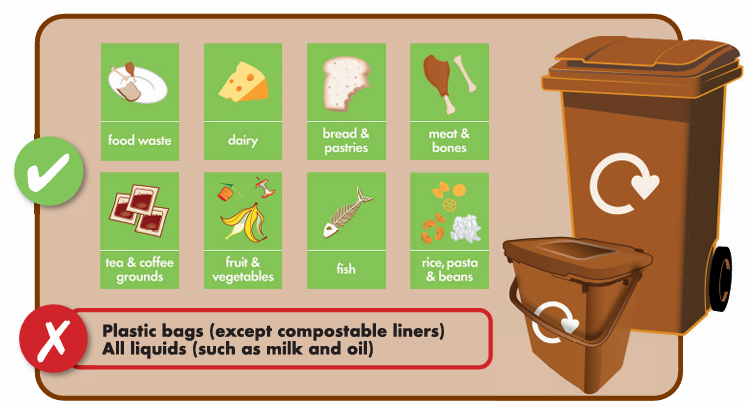
No thanks
- Plastic bags or packaging of any kind (except compostable liners, EN1342 certified)
- All liquids (such as milk and oil)
- Any material that is not food waste
If you have not received your caddy
If you haven't received a food waste caddy, or if it is damaged, bring a copy of your organic waste trial letter or your damaged caddy to Wetherby Community Hub to pick up a replacement.
If your brown wheelie bin has gone missing or is damaged, you can order a replacement bin online.
Too much waste for your bin
Brown bins are limited to one per household. If you have too much garden waste for your bin, you could try home composting. Compost is excellent for your garden or house plants, and helps the environment too.
Reporting missed brown bin collections
You can report missed bin collections online.
Cleaning your kitchen caddy
Just like your current kitchen bin, if you empty your caddy regularly, especially in hot weather, it shouldn't start to rot down and smell. After emptying, rinse your caddy with water or wipe it with kitchen roll. Using EN13432 certified compostable liners will also help to keep your caddy clean, but you can use it without these.
If you already compost food waste
Please continue to do this as it's by far the best solution for the environment and it produces excellent soil conditioner for gardens.
Reducing food waste
The average UK family could save £83 a month or around £1,000 a year, by saving food from the bin. Check out the Love Food Hate Waste website for top tips to get into good food habits, reduce your food waste and save money.
What happens to your food waste
The organic waste is turned into compost at an in-vessel composting (IVC) facility in Yorkshire. This compost, rich in a natural source of slow releasing nitrogen, is then used to make soil healthier for farming. You can find out more about this process online through Allium Energy.
Alternatives to in-vessel composting (IVC)
IVC is the best solution to turn combined food and garden waste in to compost. Alternatives, like Anaerobic Digestion (AD) are suited to processing food waste only.


