- Email: electors@leeds.gov.uk
- Post or hand delivery: Electoral Services, Civic Hall, Leeds LS1 1UR
Leeds City Council is carrying out a Community Governance Review of Garforth. A Community Governance Review provides an opportunity to consider whether local governance arrangements continue to reflect the identities and interests of the community and whether they are effective and convenient for local people.
As part of the Review, the council is inviting residents, local organisations, businesses, elected representatives and other interested parties to share their views. The Terms of Reference for the Review are set out below on this page and explain the scope of the Review, the matters being considered and how the Review will be conducted.
There are a number of ways to respond to the consultation. You can submit your views online, by email or in writing using the contact details provided on this page. All responses received during the consultation period will be carefully considered as part of the Review process.
The initial consultation period is open until 24 August 2026. We encourage everyone with an interest in the future governance arrangements for Garforth to take part and make their views known. Your feedback will help inform the council's consideration of any changes that may be proposed as a result of the Review.
Respond to the consultation onlineAlternatively you can respond to the consultation using these contact details:
View the information on this page in hard copy at:
- Electoral Services, Civic Hall, Leeds LS1 1UR
- Garforth One Stop Centre and Library, Lidgett Lane, Garforth LS25 1EH
Terms of reference
Introduction
Context
Leeds City Council has resolved to undertake a Community Governance Review (the Review) to consider the establishment of a Parish for Garforth and associated governance arrangements.
Legal framework
In undertaking the Review, the council will be guided by:
- Part 4 of the Local Government and Public Involvement in Health Act 2007
- the relevant parts of the Local Government Act 1972
- guidance on Community Governance Reviews issued in accordance with section 100(4) of the Local Government and Public Involvement in Health Act 2007 by the Department of Communities and Local Government and the Local Government Boundary Commission for England
and the following regulations which guide, in particular, consequential matters arising from the Review:
- Local Government (Parishes and Parish Councils) (England) Regulations 2008
- Local Government Finance (New Parishes) Regulations 2008
Other details
This document is being published:
- on our website at www.leeds.gov.uk/GarforthCGR
- at Electoral Services, Civic Hall, Leeds LS1 1UR
- at Garforth One Stop Centre and Library, Lidgett Lane, Garforth LS25 1EH
Reason for the Review
Why is the council undertaking a Community Governance Review at this time?
The reason for the Review is:
Receipt of a Community Governance Application from the Garforth Neighbourhood Planning Forum to consider the establishment of a Parish for Garforth and associated governance arrangements.
A copy of the Community Governance Application can be found at Appendix A to this document. A map of the proposed Parish Council area can be found at Appendix B.
What is a Community Governance Review?
A Community Governance Review is the process used to consider parish arrangements. It is a review of the whole or part of the district to consider one or more of the following:
- creating, merging, altering or abolishing parishes
- the naming of parishes and the style of new parishes
- the electoral arrangements for parishes (the ordinary year of election; council size; the number of councillors to be elected to the council, and parish warding)
- grouping parishes under a common Parish Council or de-grouping parishes
Parish governance in our area
The council believes Parish Councils play an important role in terms of community empowerment at the local level.
The council wants to ensure parish governance in our district continues to be robust, representative and enabled to meet the challenges that lie before it. Furthermore, it wants to ensure there is clarity and transparency to the areas Parish Councils represent.
It wants to ensure that the electoral arrangements of parishes – the warding arrangements and the allocations of councillors – are appropriate, equitable and readily understood by their electorate.
Who undertakes the Review?
The council is statutorily responsible for carrying out the Review.
Formal decisions on the recommendations arising from the Review will be made by Full Council, based on recommendations from General Purposes Committee, in accordance with the council’s constitution.
Consultation
How the council proposes to conduct consultations during the Review
The council has drawn up and now publishes this Terms of Reference document including a timetable of the Review at Appendix C which includes 2 periods of consultation.
This document lays out the aims of the Review, the legislation that guides it and some of the policies the council considers important.
The council will consult by:
- writing to all Parish Councils within the adjoining CGR area
- writing to Garforth and Swillington Ward Councillors and the relevant Member of Parliament
- writing to council political group leaders
- writing to identified local groups and organisations
- publicising the Review on posters in the local area
- publicising the Review on the council’s website
- targeted local comms including social media and local publications
In accordance with the Act, all representations received in connection with the Review will be taken into account, and steps will be taken to notify consultees of the outcome of the Review. This will be done by:
- the council’s website
- key documents on deposit at Garforth Community Hub and Electoral Services
- personal communication
How to contact us
If you have any questions about the community governance review, please contact Electoral Services:
Representations in response to the consultation can be provided using the above details or by completing an online consultation response form at www.leeds.gov.uk/GarforthCGR.
Electorate and population forecasts
The current electorate and 5-year forecast for the proposed Parish Council area
The council has used the Register of Electors of 1 July 2026 in providing the existing electorate and property figures for the proposed Garforth Parish Council area below.
| Polling district | Electorate | Residential properties |
|---|---|---|
| GSB | 1,109 | 619 |
| GSC | 1,433 | 856 |
| GSD | 1,108 | 742 |
| GSE | 1,616 | 1,018 |
| GSF | 1,164 | 641 |
| GSG | 1,733 | 988 |
| GSH | 2,430 | 1,305 |
| GSL | 466 | 259 |
| GSM | 805 | 429 |
| GSP | 122 | 85 |
Total |
11,986 |
6,942 |
The table below provides current population and electors with calculations for both in 5 years based on natural change and housing growth.
The table is set out in stages of the process with data sources and notes of the calculation at each stage. In summary, the current population of 15,280 increases to 15,383 with the number of electors from 11,993 to 12,074.
The information reveals modest population change from natural change and a small increase in housing growth arising in polling district GSE at land to the south of Selby Road, Garforth currently under construction.
| 1 | 2 | 3 | 4 | 5 | 6 | 7 | |
|---|---|---|---|---|---|---|---|
| Polling District | Current population | Natural change | Inc. population in 5 years (Housing) | Population in 5 years | Current electors | Electors ratio | Electors in 5 years |
| GSB | 1,478 | 1,479 | 0 | 1,479 | 1,111 | 0.75 | 1,112 |
| GSC | 1,916 | 1,917 | 0 | 1,917 | 1,430 | 0.75 | 1,431 |
| GSD | 1,631 | 1,632 | 0 | 1,632 | 1,111 | 0.68 | 1,111 |
| GSE | 2,029 | 2,030 | 97 | 2,127 | 1,612 | 0.79 | 1,690 |
| GSF | 1,271 | 1,272 | 0 | 1,272 | 1,169 | 0.92 | 1,170 |
| GSG | 2,113 | 2,114 | 0 | 2,114 | 1,733 | 0.82 | 1,734 |
| GSH | 3,057 | 3,058 | 0 | 3,058 | 2,432 | 0.80 | 2,433 |
| GSL | 604 | 605 | 0 | 605 | 465 | 0.77 | 466 |
| GSM | 1,013 | 1,014 | 0 | 1,014 | 806 | 0.80 | 807 |
| GSP | 168 | 168 | 0 | 168 | 124 | 0.74 | 124 |
| Total | 15,280 | 15,286 | 97 | 15,383 | 11,993 | 0.78 | 12,074 |
1. Current population: Local Land & Property Gazeteer on number of properties vs. ONS Output Area populations
2. Natural change: ONS 2021 Census Births vs Deaths in Strategic Housing Market Assessment sub-area (annual % change)
3. Housing Land Monitor: delivery of new housing from current pipeline (current headship rate per household)
4. Population in 5 years: current population + natural change + housing growth
5. Current electors: Leeds City Council June 2026 Register
6. Electors ratio: number of current electors vs. current population
7. Electors in 5 years: number of electors vs. population in 5 years
Council Tax precept
How much would it cost?
Parish Councils are funded through a precept, which is an amount added to Council Tax bills for properties in the parish area.
The amount is set each year by the Parish Council, depending on the services it chooses to provide. This means costs can vary.
As an example, in Leeds the average precept per year for a Band D property is £47.57. More information about Council Tax Bands can be found at www.leeds.gov.uk/council-tax/bands-and-charges.
For 2026/27, there is no government limit on parish precepts, although councils are expected to keep increases reasonable and this may change in future.
If a Parish Council is established, residents would be able to influence the precept by voting in Parish Council elections and taking part in consultation on its budget.
Parish areas
Parishes
The council is keen to ensure electors are able to identify clearly with the parish in which they are resident. It considers this sense of identity and community should:
- lend strength and legitimacy to the parish structure
- create a common interest in parish affairs
- encourage participation in elections to the Parish Council
- lead to representative and accountable government and
- generate a strong, inclusive community with a sense of civic values, responsibility and pride
The council considers parishes should reflect distinctive and recognisable communities of interest, with their own sense of identity; the feeling of local community and the wishes of local inhabitants are primary considerations in this Review.
The council is keen to balance carefully the considerations of changes that have happened over time, through population shifts or additional development for example, and have led to a different community identity with historic traditions in its area.
The council notes the government’s guidance that community cohesion should be taken into account in this Review.
The council also notes the government’s strongly stated guidance that it “expects to see a trend in the creation, rather than the abolition, of parishes” and that “the abolition of parishes should not be undertaken unless clearly justified”.
The council also notes the government considers that, where existing parishes are abolished, “it would be undesirable to see the area becoming unparished with no community governance arrangements in place”.
Boundaries
- The council considers the boundaries between parishes will normally reflect the ‘no-man’s land’ between communities represented by areas of low population or pronounced physical barriers. These barriers will be either natural or man-made. They might include coastal features, rivers, marshland, moorland and mountain or man-made features such as parks, canals, railways, major road and motorways – those barriers that oblige the residents of an affected area to have little in common with the remainder of the parish to which they may have been allotted.
- The council considers ‘natural’ settlements or settlements as they are defined in the Local Development Framework should not in normal circumstances be partitioned by parish boundaries.
- The council will endeavour to select boundaries that are and are likely to remain easily identifiable.
The pattern of community representation and community engagement
In some areas of the city there are local residents’ associations, community forums, area committees, that make a distinct contribution to the community. The council will be mindful of these local forums for community representation and engagement and will consider them as foundations for / stages towards the creation of parishes with democratically elected councils.
In our urban areas, defining the community upon which a parish might be based may be more difficult. In these areas, the council will be mindful of existing representation in a voluntary organisation or a community endeavour, which may indicate a suitable area on which to base proposals for a new or altered parish.
Viability
- The council is keen to ensure parishes should be viable and should possess a precept that enables them to actively and effectively promote the well-being of their residents and to contribute to the real provision of services in their areas in an economic and efficient manner.
- Some parishes are anxious to take on the new power of well-being provided in the Local Government and Public Involvement in Health Act 2007; others hold Quality Parish status, while others are keen to enter into charters with principal councils for the provision of local services. The council sees these initiatives as important measures of effective and convenient local government and will respect them in this Review.
- The council recognises that, in its rural areas, a strong sense of community can prevail over an extensive but otherwise sparsely populated area. Parishes in these areas may have limited capacity to facilitate service provision and effective local government; even so, arrangements in these areas, when they accord with the wishes of the inhabitants of the parish, will at least represent convenient local government.
Conclusion
The council is committed to ensuring the Review leads to a parish that is based on an area which reflects community identity and interest, and which is viable as an administrative unit.
Names and styles
The naming of parishes
With regard to the names of parishes, the council will endeavour to reflect existing local or historic placenames. The council will favour names proposed by local interested parties.
The council considers composite names of parishes are rarely in the interests of effective and convenient local government. The council would wish to avoid composite names other than in exceptional circumstances where the demands of history, local connections or the preservation of local ties make a pressing case for the retention of distinctive traditional names.
There are legal requirements, particularly relating to subsequent notification, with regard to the naming of parishes, and the council will be mindful of these.
Alternative styles
Where a new parish is being created, the council will make recommendations as to the geographical name of the new parish and whether it should have one of the alternative styles.
For example, a new parish and Parish Council could be called:
- the parish of Garforth; and Garforth Parish Council
- the town of Garforth; and Garforth Town Council
- the community of Garforth; and Garforth Community Council
- the neighbourhood of Garforth; and Garforth Neighbourhood Council
- the village of Garforth; and Garforth Village Council
Electoral arrangements
What does ‘electoral arrangements’ mean?
An important part of our Review will include giving consideration to ‘electoral arrangements’. The term covers the way in which a council is constituted for the parish. It covers:
- the ordinary year in which elections are held
- the number of councillors to be elected to the council
- the division (or not) of the parish into wards for the purpose of electing councillors
- the number and boundaries of any such wards
- the number of councillors to be elected for any such ward
- the name of any such ward
Ordinary year of election
The Review may find it appropriate to hold an election for parish councillors, for example to a newly formed parish, at an earlier date than the next scheduled ordinary elections in May 2027.
Where this occurs the terms of office of any newly elected parish councillors will be reduced to enable the electoral cycle to revert to the normal cycle in the district at the next ordinary elections.
Political composition of a future Parish Council
The Review cannot determine or restrict the future political composition of any Parish Council. Should a Parish Council be created, the political make-up of the council would be determined by the individuals elected by local residents, together with any councillors subsequently appointed through the co-option process. Therefore, any suggestion that a future Parish Council would operate on a non-political basis cannot be guaranteed through the Review process and would ultimately depend on the councillors who serve on the council.
A council for a parish
The legislation lays down the different duties the council has with regard to the creation of a council for a parish:
- where the number of electors is 1,000 or more – a Parish Council must be created
- where the number of electors is 151-999 – a Parish Council may be created, with a parish meeting being the alternative form of parish governance
- where the number of electors is 150 or fewer – a Parish Council is not created
What considerations cover the number of parish councillors?
The council notes the number of parish councillors for each Parish Council shall not be less than 5. There is no maximum number.
There are no rules relating to the allocations of councillors.
The government’s guidance is “each area should be considered on its own merits, having regard to its population, geography and the pattern of communities,” and therefore the council is prepared to pay particular attention to:
- existing levels of representation
- the broad pattern of existing council sizes which have stood the test of time
- the take-up of seats at elections in its consideration of this matter
The National Association of Local Councils (NALC) suggest the minimum number of councillors should be 7, and the maximum 25.
The present levels of councillors in parishes in the Leeds City Council area, and how many of those Parish Council seats were filled by co-option at the May 2023 all out Parish Council elections are shown below.
| Parish Council | Electorate | Councillors | Seats co-opted in 2023 |
|---|---|---|---|
| Aberford and District | 1,491 | 11 | 6 |
| Allerton Bywater | 3,928 | 10 | 0 |
| Alwoodley | 6,878 | 11 | 4 |
| Arthington | 440 | 5 | 1 |
| Bardsey cum Rigton | 1,822 | 9 | 0 |
| Boston Spa | 3,493 | 10 | 3 |
| Bramham cum Oglethorpe | 1,376 | 9 | 0 |
| Bramhope and Carlton | 3,433 | 13 | 0 |
| Clifford | 1,455 | 9 | 3 |
| Collingham with Linton | 2,512 | 10 | 6 |
| Drighlington | 4,724 | 12 | 3 |
| East Keswick | 914 | 7 | 4 |
| Gildersome | 4,409 | 13 | 0 |
| Great and Little Preston | 1,447 | 9 | 5 |
| Harewood | 2,870 | 9 | 5 |
| Horsforth | 15,738 | 22 | 0 |
| Kippax | 7,681 | 16 | 3 |
| Ledsham | 134 | 7 | 0 |
| Micklefield | 2,368 | 9 | 9 |
| Morley | 27,373 | 26 | 0 |
| Otley | 11,252 | 15 | 0 |
| Pool | 1,809 | 9 | 2 |
| Rawdon | 5,245 | 9 | 0 |
| Scarcroft | 1,229 | 9 | 6 |
| Shadwell | 1,502 | 9 | 1 |
| Swillington | 2,518 | 9 | 1 |
| Thorner | 1,275 | 9 | 3 |
| Thorp Arch | 847 | 7 | 2 |
| Walton | 165 | 7 | 2 |
| Wetherby | 9,158 | 15 | 4 |
By law, the principal council must have regard to the following factors when considering the number of councillors to be elected for the parish:
- the number of local government electors for the parish
- any change in that number which is likely to occur in the period of 5 years beginning with the day when the Review starts
Parish warding
The Act requires that in considering whether a parish should be divided into wards for the purposes of elections of the Parish Council the council should consider the following:
- whether the number, or distribution, of the local government electors for the parish would make a single election of councillors impracticable or inconvenient
- whether it is desirable that any area or areas of the parish should be represented separately on the council
The council will be mindful of the government guidance on parish warding, noting “each case should be considered on its merits and on the basis of the information and evidence provided during the course of the Review.”
The number and boundaries of parish wards
In reaching conclusions on the boundaries between parish wards, the council will consider community identity and interests in an area and will take into account whether any particular ties or linkages might be broken by the drawing of particular ward boundaries. Equally, the council, during its consultations is mindful that proposals which are intended to reflect community identity and local linkages should be justified in terms of sound and demonstrable evidence of those identities and linkages.
The council has noted the desirability of fixing boundaries which are, and will remain, easily identifiable, as well as taking into account any local ties which might be broken by the fixing of any particular boundaries.
The Guidance has suggested a relevant consideration for the council when undertaking a Review is the district should not spilt an unwarded parish and no parish ward should be split by such a boundary.
The relevant legal provisions do not apply to reviews of parish electoral arrangements, but the Local Government Boundary Commission has requested the council to bear this in mind, which the council will do.
In the naming of parish wards, the council will be mindful of existing local or historic place names, and there will be a presumption in favour of ward names proposed by local interested parties.
The number of councillors to be elected for parish wards
The council has noted it is required to have regard to the following when considering the size and boundaries of the wards and the number of councillors to be elected for each ward:
- the number of local government electors for the parish
- any change in the number, or distribution, of the local government electors which is likely to occur in the period of 5 years beginning with the day when the Review starts
The government has advised, and this council concurs “it is an important democratic principle that each person’s vote should be of equal weight so far as possible, having regard to other legitimated competing factors, when it comes to the elections of councillors.”
While there is no provision in legislation that each parish councillor should represent, as nearly as may be, the same number of electors, the council considers it is not in the interests of effective and convenient local government, either for voters or councillors, to have significant differences in levels of representation between different parish wards.
The council is likewise keen to avoid the risk, where one or more wards of a parish are over-represented by councillors. The residents of those wards (and their councillors) could be perceived as having more influence than others on the council.
During the Review process and in its consultations, the council is committed to consistently showing the ratios of electors to councillors that would result from its proposals.
The foregoing considerations of being equitable will also guide the council when it considers the number of councillors to be elected to a common council by each parish within a grouping arrangement.
Naming of parish wards
With regard to the names of parish wards, the council will endeavour to reflect existing local or historic placenames and will give a strong presumption in favour of ward names proposed by local interested parties.
Reorganisation of community governance orders and commencement
Completion of the Review
The Review will be completed when the council adopts the Reorganisation of Community Governance Order, or resolves at Full Council not to approve a Parish Council for Garforth.
The document(s) which set out the reasons for the decisions the council has taken (including copies of the Order and the map(s) that show the effects of the Order (if applicable) will be deposited at Electoral Services, Civic Hall, Leeds LS1 1UR, at www.leeds.gov.uk/GarforthCGR and at Garforth One Stop Centre and Library, Lidgett Lane, Garforth LS25 1EH.
In accordance with the guidance issued by the government, the council will issue maps to illustrate each recommendation at a scale that will not normally be smaller than 1:10,000. These maps will be deposited with the Secretary of State at the Department of Levelling Up, Housing and Communities and at the council’s office at Civic Hall, Leeds LS1 1UR.
Prints will also be supplied, in accordance with regulations, to Ordnance Survey, the Registrar General, the Land Registry, the Valuation Office Agency, the Boundary Commission for England and the Local Government Boundary Commission for England.
Should the Review determine a Parish Council be created, it is anticipated that:
- the financial and administrative provisions of the reorganisation order will come into force on or before 29 March 2027
- the electoral arrangements would come into force on 6 May 2027
Consequential matters
General principles
The council notes that a Reorganisation Order may cover any consequential matters that appear to the council to be necessary or proper to give effect to the Order. These may include:
- the transfer and management or custody of property
- the setting of precepts for new parishes
- provision with respect to the transfer of any functions, property, rights and liabilities
- provision for the transfer of staff, compensation for loss of office, pensions and other staffing matters
In these matters, the council will be guided by Regulations that have been issued following the 2007 Act.
In particular, the council notes that the Regulations regarding the transfer of property, rights and liabilities require that any apportionments shall use the population of the area as estimated by the proper officer of the council as an appropriate proportion.
District ward boundaries
The council is mindful it may be necessary for it to recommend the Local Government Boundary Commission to make alterations to the boundaries of district wards or county electoral divisions to reflect the changes made at parish level. The council notes it will be for the Local Government Boundary Commission to decide if:
- related alterations should be made
- when they should be implemented, and
- whether it is appropriate to conduct an electoral review of affected areas
The council notes the Local Government Boundary Commission will require evidence that the council has consulted on any such recommendations for alterations to the boundaries of district wards or county electoral divisions as part of the Review. Of course, such recommendations for alterations may only become apparent during the course of the Review. Even so, the council will endeavour to include any such draft recommendations for alterations at the earliest possible opportunity for consultation that will arise after they become apparent.
Date of publication of these terms of reference: 20 July 2026
Appendix A - Community Governance Application submitted by Garforth Neighbourhood Planning Forum
Application for a Garforth Parish Council
1. The Garforth Neighbourhood Planning Forum wishes to apply for a Community Governance review to create a new Parish Council for Garforth.
1.1 The name of which would be Garforth Parish Council.
1.2 It is hoped that this can be established by May 2027.
2.
This application meets the criteria identified in the Leeds Parish and Town Council Charter and the Community Governance application 80A (3) (4) (5) (6) identified / stated in the Local Government and Public involvement Act.
3. Background and rationale
3.1 There is a precedent for this request.
3.2 From the establishment of Parish Councils in 1894 a Garforth Parish Council managed local affairs. In 1908 the Garforth Urban District Council was established and provided all the civic duties, housing and town planning for Garforth, Allerton Bywater and Kippax. In 1974 under the Local Government reorganisation Garforth, Allerton Bywater and Kippax were incorporated into Leeds City Council and became separate wards.
3.3 In 1998 Allerton Bywater and in 2004 Kippax applied to Leeds City Council and were granted Parish Council status. Garforth is the only settlement in the area that is not represented by a Parish Council.
3.4 The Garforth Neighbourhood Planning Forum was designated in 2014 to prepare a Neighbourhood Plan. This has been completed, submitted for examination, passed at a referendum and ‘made’. There is now a subsequent need to monitor the implementation of the plan and continue to inform, seek and represent the views of the local community on planning issues. However, without access to manpower and funds this is extremely difficult if not impossible to achieve.
3.5 During the preparation of the Garforth Neighbourhood plan the forum held many consultations and surveys which provided opportunities for residents to voice their concerns about the facilities, services and the future of Garforth.
3.6 Garforth need the stability of a formal, legally constituted Parish Council, which would bring with it legal powers, duties, elected councillors and access to funds.
3.7 There are clear advantages to the community of a Parish Council, as opposed to a Parish meeting or other community body. A Parish Council would have a direct line of communication with and be formally consulted by Leeds City Council.
4. The benefits to the community of a Parish Council
4.1
- A Garforth Parish Council would be non-political and work in collaboration with elected ward councillors, as in other parishes.
- It would have the democratic mandate to represent the views of Garforth residents when discussing major issues relating to Garforth.
4.2 A Parish Council would sit alongside our ward councillors who would be greatly welcomed at meetings, owing to their long and valued experience in Garforth, as an additional voice to:
- promote the health and well-being of everyone who lives and works in Garforth
- help to ensure that Garforth remains a separate and a distinctive settlement
- protect and improve access to essential health, educational services, green spaces, leisure and community activities
- support Main Street, local employment and public transport
- ensure that any CIL money due from current construction in Garforth would only be spent in Garforth and not in the wider ward of Garforth and Swillington
- further support and encourage local community groups
4.3 Garforth is a thriving community and a Parish Council would further promote community cohesion and provide a greater sense of distinctive local identity, for example, working with local charities to organise community events.
4.4 It would also provide an opportunity to work with neighbouring Parish Councils, the Outer East Community Committee, schools and churches to share ideas and collaborate where appropriate, for example, upgrading and maintaining Green Corridors and environmental issues.
5. Proposed composition of the Garforth Parish Council
5.1 Having taken advice from the Yorkshire Local Government Association, it is understood that Leeds City Council will assist in the allocation of wards, setting precepts and determining what services will be passed to the responsibility of a new Parish Council.
5.2 The boundary of the proposed parish includes the majority of the area known as Garforth which is not covered by any neighbouring Parish Councils (Aberford and Barwick). It is shown on the attached map.
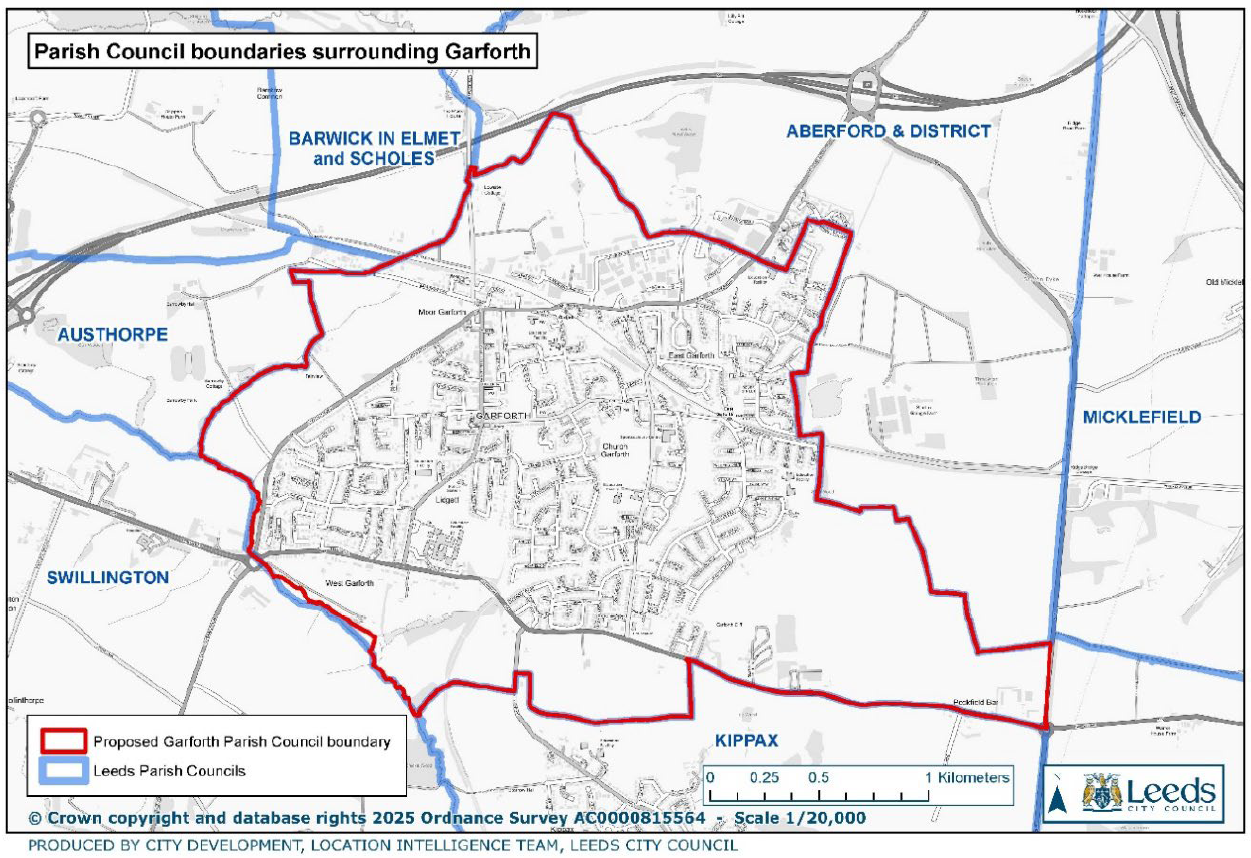
5.3 There are 10 polling districts and 12,003 electors.
5.4 The organisation of a Garforth Parish Council could be similar to that of Kippax with 3 wards and 15 councillors.
5.5 Garforth could be split into:
- West Garforth
- Moor/Church Garforth
- East Garforth
5.6 These suggested wards are based on the original maps of the area and reflect the development of Garforth by new estates from west to east.
- Moor/ Church Garforth is the site of the original settlement based on Townend, Main Street and Lidgett Lane bordered by the A642 Aberford Road and the A63 to the south.
- West Garforth includes the first major estate development bordered by the Wakefield and Selby Roads.
- East Garforth situated on the east and south east of Garforth, reflecting subsequent major estate developments, bordered by the Aberford Road to the north and the Selby Road to the south.
6.
It is recognised that there would need to be an interim/provisional Parish Council organisation prior to the election of Parish Councillors and advice from Leeds City on the allocation of polling districts to the 3 wards would be welcomed.
Appendix B - Detailed map of the proposed Garforth Parish area
Appendix C - Review timetable
| Stage | Task(s) | Timescale | Date(s) |
|---|---|---|---|
| Start | Receipt of application | N/A | 17 June 2026 |
| Preparation | Validation of application Desk research and information gathering Preparation of Terms of Reference (ToR) |
3 weeks | w/c 22 June 2026 22 June – 3 July 2026 w/c 6 July 2026 |
| Agreement of ToR at General Purposes Committee (GPC) | 13 July 2026 | ||
| Stage 1 | Publication of ToR triggering the start of the review | 5 weeks | 20 July 2026 |
| Public consultation – initial submissions are invited | 20 July – 24 Aug 2026 | ||
| Stage 2 | Consideration of submissions received Preparation of draft recommendations |
7 weeks | 25 Aug – 22 Sept 2026 |
| Approval of draft recommendations at GPC | 14 Oct 2026 | ||
| Stage 3 | Publication of draft recommendations marking the start of a second period of public consultation | 4 weeks | 14 Oct 2026 – 11 Nov 2026 |
| Stage 4 | Consideration of submissions received Preparation of final recommendations |
9 weeks | 12 Nov – 3 Dec 2026 |
| Final recommendations taken to GPC (to make a recommendation to Full Council) | 16 Dec 2026 | ||
| Full Council meeting | January 2027 (date TBC) | ||
| Publication of final recommendations – concluding the review | 3 weeks | 18 Jan 2027 | |
| Making of Reorganisation Order (if approved) | Not later than 29 March 2027 | ||
| If approved - elections held on 6 May 2027. | |||


